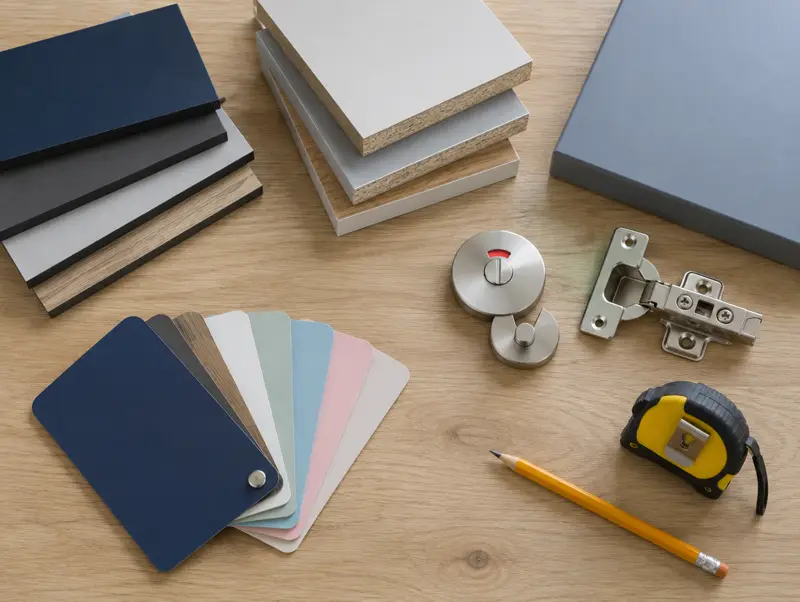
The three materials in plain terms
| Material | What it is | Water resistance | Typical life in a busy washroom |
|---|---|---|---|
| MFC | 18mm chipboard with a melamine face and sealed edges | Low: the core swells if water gets in | Shortest |
| HPL-faced chipboard | Chipboard with a thin high-pressure laminate skin | Moderate: better face, same core | Medium |
| Compact laminate (SGL) | Solid 12–13mm board made entirely of HPL layers | High: waterproof through its thickness | Longest |
When MFC is the right answer
MFC is the lowest-cost option and looks smart on day one. It suits small offices and staff areas where floors are dry-mopped and use is light. It is not suitable for showers, changing rooms, schools or public washrooms.
Why compact laminate wins on whole-life cost
Compact laminate costs more to buy but rarely needs replacing. It can be wet-cleaned, resists impact and graffiti, and fixings stay tight in the solid board. In most commercial washrooms that makes it cheaper over ten years than replacing chipboard doors as they swell and fail.
Where flush-fronted systems fit
Flush-fronted cubicles use thicker boards, often with a compact laminate face, to create a smooth front with hidden hinges. They are a design choice rather than a material grade, and suit offices and hospitality.

Written by the Washroom Cubicles technical team. We design and install commercial washrooms across England, Scotland and Wales. Last reviewed 8 October 2026. Regulations change, so confirm requirements for your project with your building control body.